


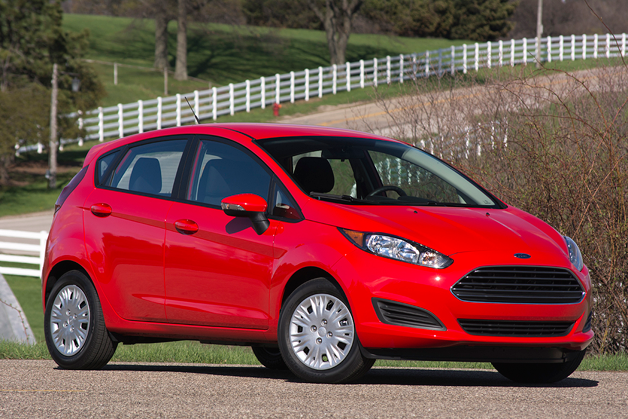
I'll be honest; when Ford first unveiled its 3.5-liter EcoBoost V6, I was skeptical. Past attempts at building turbocharged American cars were almost universally awful, I reasoned, so why would Ford's latest effort be any different? This may seem foolish today, considering the success that the growing EcoBoost range has achieved - particularly the 2.0-liter and 1.6-liter mills. Yet I once again found myself questioning Ford.
It's the makeup of the 1.0-liter, turbocharged three-cylinder slotted into the compact engine bay of this Fiesta that has a way of breeding doubt. Three-cylinder engines remain an extreme rarity in the US. What's more, they earned a less-than-desirable reputation for applications in the 1980s and 1990s, and my trepidation about this latest three-pot as a result.
As I found out, though, history is a poor informant of modern technology. The thrust available in other cars with the EcoBoost badge on the back has not gone missing here; something the International Engine of the Year committee has lauded. That august body named the 1.0-liter Ecoboost the best engine of 2012 and 2013. After a week of driving, it didn't take long for my fear of threes to get turned into something like that line of thinking.
Driving Notes
- How much power can a 1.0-liter, turbocharged three-cylinder that's small enough to go through an airport x-ray machine really produce? 90 horsepower, maybe 100, right? There's not much wrong with that specific output. The reality is more impressive, though. The 1.0 in the Fiesta turns out 123 ponies and 125 pound-feet of torque. Dig into the throttle, and the heroic little mill can call up a total of 148 pound-feet of torque, courtesy of an overboost function. Perhaps most impressive is that peak torque is available at just 1,400 rpm. For reference, the standard 1.6 in the Fiesta only pumps out 120 hp and 112 lb-ft of torque - so yes, this little triple is actually more powerful.
- The result of all this easily accessible grunt is ridiculously, hilariously good. The Fiesta pulls with a diesel-like sense of authority, regardless of gear or engine speed, and had little difficulty when it came to on-ramps or highway merging, where power is most likely to be needed. Throughout my week, every single situation I put the 1.0-liter in, it wowed with its super accessible acceleration. Put another way, if this engine were in a Pepsi Challenge with the standard 1.6, I'm convinced it'd win every time.
- As low and mid-range output are this engine's strongest assets, the transmission should be geared to exploit that. In the Fiesta, it is. The five-speed manual isn't great to work with, with long throws and a vague clutch, but it's geared perfectly for this engine. At 80 mph, the engine turns over at just 3,000 rpm. At 70, it spins at 2,500. And yet, the gearing is broad enough and the power ample enough that you won't be forced to work the clutch and transmission too much to get about. This powertrain is just very, very easy to drive and live with.
- For those that are concerned about the engine's sound, well, don't be. Sure, it's a bit clattery when idling and it doesn't sound great when accelerating hard, but it's not a buzzy or harsh engine, and it's darn near silent at cruising speeds, even when turning over at 3,000 rpm.
- There are a fair few flies in this ointment, though. First and foremost, we have fuel economy. Ford rates the Fiesta EcoBoost at 32 miles per gallon in the city and 45 mpg on the highway. I didn't have much difficulty matching the 37-mpg combined rating, and the EcoBoost's ratings are noticeably better than the 1.6, which returns 30 and 41 mpg when fitted with a manual transmission and the SFE package. The problem, as I see it, is this: there's a stigma against super-small engines like the 1.0, and unless they provide some ridiculous improvements in fuel efficiency, consumers will dismiss them outright. As of this writing, I simply don't think there's enough of a benefit to tempt the average buyer to get behind the wheel and find out how good this engine really is.
- I think this is solvable problem, though, if Ford opts to develop the Fiesta EcoBoost as a fuel-sippers choice. Start-stop would be a natural fit here, as would active grille shutters and, perhaps, the excellent suite of efficiency training systems found on Ford's hybrid and electric offerings. It would add some to the cost (perhaps $295?) but it would fit with Ford's plan to introduce that technology to more models. It's not likely to provide a huge bump in the EPA sticker numbers, but the real-world improvement could be enough for Joe Consumer to decide to take it for a spin, just to see what it's all about.
- The Fiesta SE starts at $16,080 for the five-door model, which doesn't include an $825 destination charge. Adding the three-pot turbo kicks the price up $995. It's a reasonable sum, considering the premiums that other EcoBoost mills offer, and one that I wouldn't be too miffed about paying. My tester also featured a $290 Comfort Pack, which added heated seats. Beyond that, the only other options worth mentioning are MyFord Touch and a sunroof, both of which add $795 apiece to the Fiesta's bottom line (although my car didn't have either). As tested, the car you see above is $18,190, including destination.
- A final problem, as I see it, is that Ford hasn't done a lot to make this a very appealing engine to customers. It's only available on the mid-level SE trim, and can only be had with a five-speed manual and 15-inch steel wheels. It is, at least, available in both sedan and five-door models. If the ho-hum fuel mileage doesn't doom Fiesta EcoBoost sales, the fact that its availability is so limited will. But this is the first year the 1.0 is on sale in the US, so it's entirely plausible that Ford is waiting to see what the initial consumer and critical response is before making it more widely available. Here's hoping that's the case.
This post was made using the Auto Blogging Software from WebMagnates.org This line will not appear when posts are made after activating the software to full version.


