Showing posts with label Earnings/Financials. Show all posts

Wednesday, May 14, 2014

Former Treasury boss unaware auto task force fired GM's Wagoner

Books-GeithnerWe dig a good political tell-all every once in a while (how else will we get our political fix while waiting for House of Cards' third season?). Today, we get just that from former Treasury Secretary Timothy Geithner's new book, "Stress Test," which details, among other parts of the 2009 financial catastrophe, the structured bankruptcy that allowed Chrysler and General Motors to emerge as competitive players in the auto industry.

In the book, which is nicely recapped by The Detroit News, Geithner discusses the firing of GM CEO Rick Wagoner while explaining how much trust he had in the auto industry task force that executed the move without his knowledge.

Auto Czar Steve Rattner "didn't even consult me before he fired General Motors CEO Rick Wagoner; if anything, that move increased my confidence in Team Auto," Geithner wrote.

Geithner also details how badly GM miscalculated the government's position while pointing out that President Obama "never seriously" considered letting GM or Chrysler fail. There are some controversial views, however. Geithner defended the decision to go harder on the automakers, while making sure banks didn't suffer to heavily.

It's really worth a read, particularly if you are, like us, a student of the industry and the 2009 bailout. Hop over to The Detroit News website, have a look at some snippets from the book and then let us know what you think in Comments.
This post was made using the Auto Blogging Software from WebMagnates.org This line will not appear when posts are made after activating the software to full version.

White House urges Congress to shore up depleted Highway Trust Fund

New Bay Bridge


The United States Highway Trust Fund is getting closer to running out, and the federal government is scrambling to find a way to keep it in the black. The fund pays for a significant portion of the upkeep for the country's interstates, bridge repairs and some public transportation projects. It's currently backed under a two-year law that expires in September, but Secretary of Transportation Anthony Foxx claims the actual money in the account will be gone by the end of August. Without new financing, the depletion stands to affect 112,000 ongoing projects and about 700,000 jobs, according to The Wall Street Journal.

The Obama administration and Foxx have already presented a four-year funding bill that would end a tax break for businesses and give states the ability to charge tolls on interstates to raise money for upkeep. But the President's plan is raising controversy from Republican legislators who don't want to change taxes for businesses, especially in an election year. According to Bloomberg Businessweek, Foxx still hopes to close a loophole in companies' deferring taxes on overseas earnings that could raise $150 billion.

The current funding is provided by an 18.4-cent-per-gallon federal tax on gasoline. However, the latter hasn't been raised since the '90s. With more efficient cars and no adjustment, the tax just isn't providing enough money to keep up with needed repairs. The Highway Trust Fund provides about a quarter of the annual public spending on roadway projects, according to the WSJ.

There is an alternative bipartisan bill in the Senate, notes Businessweek. The six-year plan would continue funding at $105 billion a year (plus inflation) but at the moment, it doesn't say where that money will actually come from. That part is being left for later.

The legislative and executive branches still have a few weeks to hammer out a deal over how to pay for America's highway upkeep. While that happens, the future of our nation's roads appears to hang in the balance.
This post was made using the Auto Blogging Software from WebMagnates.org This line will not appear when posts are made after activating the software to full version.

Foreign car sales on the rise in Japan

2014 Maserati Ghibli sedan - front three-quarter view


Historically, the Japanese auto market has been a tough nut to crack for foreign automakers. The country's buyers have a reputation of preferring driving vehicles from domestic companies. However, the last fiscal year that ended in March indicated that things don't have to be so insular. As Japan's economy improved, imported models have seen their sales surge.

According to Bloomberg, the last fiscal year was one of the best ever for foreign automakers in Japan. There were 302,000 imported vehicle sales, the best since 1997, and they had an 8.8 percent of the non-kei car market share, the highest since 1989. Granted, domestic cars still dominated the market with roughly 90 percent of the country's business.

Volkswagen led Japan in terms of units sold at about 72,000 cars, and the Golf was the single best-selling foreign model, with about 31,000 sold. However, Maserati saw the biggest gains, with sales more than doubling to about 714 vehicles. Even Mercedes-Benz saw about a 40 percent gain, with the new A-Class accounting for about a quarter of its models.

Unfortunately, the boom may be short-lived. Japan instituted a higher consumption tax in April, and auto sales took a tumble. According to Bloomberg, the first month after the increase foreign deliveries dropped 24 percent, and the overall market fell 5.5 percent. However, analysts predict that if the economy improves, then import sales could rebound anew.
This post was made using the Auto Blogging Software from WebMagnates.org This line will not appear when posts are made after activating the software to full version.

Tuesday, May 13, 2014

Detroit automakers mulling helping DIA avoid bankruptcy looting

Detroit Bankruptcy Art


It's not really a secret that the city of Detroit is in lots and lots of trouble. Even with an emergency manager working to guide it through bankruptcy, a number of the city's institutions remain in very serious danger. One of the most notable is the Detroit Institute of Arts, a 658,000-square-foot behemoth of art that counts works from Van Gogh, Picasso, Gauguin and Rembrandt (not to mention a version of Rodin's iconic "The Thinker," shown above) as part of its permanent collection.

Throughout the bankruptcy, the DIA has been under threat, with art enthusiasts, historians and fans of the museum concerned that its expansive collection - valued between $454 and $867 million by Christie's - could be sold by the city to help square its $18.5-billion debt.

Now, though, Detroit's hometown automakers could be set to step up and help save the renowned museum. According to a report from The Detroit News, the charitable arms of General Motors, Ford and Chrysler could be set to donate $25 million as part of a DIA-initiated campaign, called the "grand bargain." As part of the deal, the DIA would seek $100 million in corporate donations as part of a larger attempt at putting together an $816-million package that would be paid to city pension funds over 20 years. Such a move would protect the city's art collection from being sold off.

The charitable donation is still far from a done deal, though, largely because of legal complications inherent in such a large bankruptcy case. According to The DetNews, there's concern among business leaders approached by the DIA (which in addition to the automakers include utility provider DTE Energy, Roger Penske and Quicken Loans) that the entire project could fall apart if city lawmakers don't act on it quickly. Alternatively, the deal could crumble if plans put before the city's pensioners and unions ends up failing.

"Ford has been a long-time supporter of the DIA and its contributions to southeast Michigan. We are having confidential discussions with the DIA and are considering the matter very carefully," Ford spokesman Todd Nissen told The News.

"The DIA must be central to any plans for a revitalized Detroit. Both GM and the GM Foundation are giving careful consideration to how we can help preserve this treasure at such a critical time," GM spokesman Greg Martin said.

Chrysler issued a shorter statement, telling The Detroit News that it "is committed to playing a positive role in Detroit's revitalization. Accordingly, we are reviewing the DIA's request."
This post was made using the Auto Blogging Software from WebMagnates.org This line will not appear when posts are made after activating the software to full version.
Monday, May 12, 2014

Fiat Chrysler posts $690M Q1 loss

Fiat Chrysler


If there is one thing that should be remembered when looking at quarterly and annual earnings, it's that the headline numbers rarely tell the whole story when it comes to an automaker's health. Chrysler's first-quarter earnings are just such an example.

Yes, the Auburn Hills-based manufacturer lost $690 million, which is quite a large sum of money. The reasons for the loss, according to Chrysler, were "Unfavorable infrequent items," which includes a $504 million payment to rid itself of the debts it took on for prepaying the UAW's VEBA healthcare trust. Chrysler was also hit with a $672 million charge to the UAW, which was part of a deal that allowed Fiat to purchase the remaining shares of Chrysler owned by the VEBA.

Ignoring those one-time deals, the first quarter was quite a successful one for Chrysler. It would have made $486 million if you erased the merger costs, which would have been a year-over-year increase of $320 million. Even more promising is the fact that Chrysler snagged the largest increase in market share of any automaker during Q1 at 1.1 percent, bringing its overall share to 12.7 percent of the US market. Chrysler saw a 30-percent improvement in sales of trucks and SUVs, along with an 11-percent increase in year-over-year sales and a 23-percent increase in revenue, to $19 billion.

Overall, not a bad first quarter for Chrysler, provided you ignore its one-time costs. With those merger-related charges settled, it should be pretty interesting to see how Chrysler does in the rest of 2014.
This post was made using the Auto Blogging Software from WebMagnates.org This line will not appear when posts are made after activating the software to full version.

Tesla pulling plug on Toyota RAV4 EV battery deal

2012 Toyota Rav4 EV


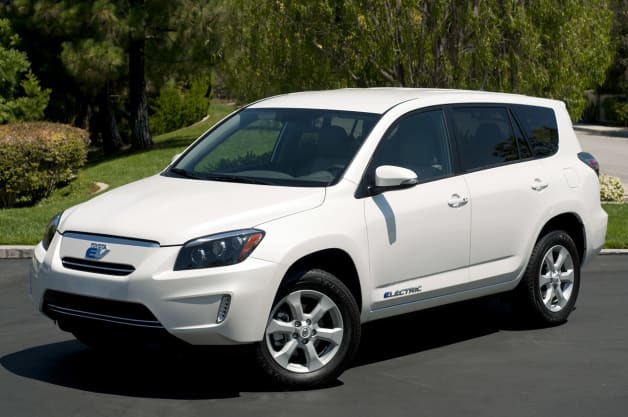
The future of the Toyota RAV4 EV appears to be in doubt. Tesla supplies the EVs battery packs, and it says that production ends later this year.

"Toyota is expected to end the current RAV4 EV model this year," Tesla said in its quarterly financial filing obtained by Bloomberg. "Our production activities under this program are expected to end in 2014," the company said.

This timeline fits closely with the original production plans for the RAV4 EV. When the $100-million project was first announced, Tesla said that it expected to supply battery packs for the vehicle from 2012 to 2014. Building components for the Japanese automaker continues to bring in money, though. In the company's Q1 2014 letter to shareholders, it said: "Automotive revenue included $15 million of Toyota powertrain sales." According to Bloomberg, Toyota has sold just 1,594 RAV4 EV models from 2012 through April 2014. Initially, the business had estimated that it would sell 2,600 units of the electrified crossover.

Toyota has not officially said that it plans to end production of the RAV4 EV yet. Of course, doing so wouldn't really come as a shock, since the vehicle is still based on a previous generation platform. Toyota is also known to be readying its FCV Concept hydrogen vehicle for production in 2015. The cutting-edge model might appeal to a different market, but it will still help the Japanese automaker maintain its leadership in electric propulsion.

Autoblog has reached out to Toyota asking for comments on the future of its RAV4 EV and will update this story if we learn more.
This post was made using the Auto Blogging Software from WebMagnates.org This line will not appear when posts are made after activating the software to full version.

Tesla pulling plug on Toyota RAV4 EV battery deal

2012 Toyota Rav4 EV


The future of the Toyota RAV4 EV appears to be in doubt. Tesla supplies the EVs battery packs, and it says that production ends later this year.

"Toyota is expected to end the current RAV4 EV model this year," Tesla said in its quarterly financial filing obtained by Bloomberg. "Our production activities under this program are expected to end in 2014," the company said.

This timeline fits closely with the original production plans for the RAV4 EV. When the $100-million project was first announced, Tesla said that it expected to supply battery packs for the vehicle from 2012 to 2014. Building components for the Japanese automaker continues to bring in money, though. In the company's Q1 2014 letter to shareholders, it said: "Automotive revenue included $15 million of Toyota powertrain sales." According to Bloomberg, Toyota has sold just 1,594 RAV4 EV models from 2012 through April 2014. Initially, the business had estimated that it would sell 2,600 units of the electrified crossover.

Toyota has not officially said that it plans to end production of the RAV4 EV yet. Of course, doing so wouldn't really come as a shock, since the vehicle is still based on a previous generation platform. Toyota is also known to be readying its FCV Concept hydrogen vehicle for production in 2015. The cutting-edge model might appeal to a different market, but it will still help the Japanese automaker maintain its leadership in electric propulsion.

This post was made using the Auto Blogging Software from WebMagnates.org This line will not appear when posts are made after activating the software to full version.